I have been reviewing pen and paper products for almost four years now. I've reviewed notebooks from Asia, Europe, and mostly from the United States, but I have not had a glimpse of a Field Notes pocket notebook yet. Back then, I didn't like small notebooks, and Field Notes was not available here in the Philippines. Last December though, a local online shop announced that they are selling the Field Notes Brand, beginning with the Winter 2011 Colors Release, The Northerly. I knew I had to get my own set the moment I saw the bright white notebooks. Never mind that I don't like small notebooks.
Tuesday, 17 January 2012
Notebook Review: The Northerly by Field Notes
I have been reviewing pen and paper products for almost four years now. I've reviewed notebooks from Asia, Europe, and mostly from the United States, but I have not had a glimpse of a Field Notes pocket notebook yet. Back then, I didn't like small notebooks, and Field Notes was not available here in the Philippines. Last December though, a local online shop announced that they are selling the Field Notes Brand, beginning with the Winter 2011 Colors Release, The Northerly. I knew I had to get my own set the moment I saw the bright white notebooks. Never mind that I don't like small notebooks.
Monday, 12 December 2011
Notebook Review: Banditapple Carnet
I first read about Banditapple Carnet notebooks in June when my friend Julie wrote a review in her blog. Out of curiosity, I sent an email to Banditapple's creator and owner, Arnie Kim, to ask for sample products to review on the blog. Three months of waiting and chasing the guys at our Post Office, I received the lovely notebooks that Arnie sent to me.
Banditapple Carnet notebooks are sold by its creator and owner, Arnie Kim from Seoul, South Korea, though they are all hand-made in Vietnam. Arnie said that his notebooks are now available in stationery stores not only in South Korea, but also in selected stores in Japan.
The notebooks come in three sizes (Peewee, Handy, and Tablet) and two cover colors (Hanoi Red and Saigon Black). All Banditapple Carnet notebook sizes are available in either blank or ruled paper with 64 pages of acid-free, 80gsm off-white paperstock. The cover used on the notebooks is plain cardstock which makes them look very simple, and almost anonymous and unbranded. But I like that. I'm also glad that Arnie sent me samples of all available notebook sizes and covers, and that he sent me notebooks with both blank and ruled pages.
Handy, the 'middle' size, measures 4.25 x 8.25 inches. This notebook made me very happy as soon as I saw it. Why? Because it's the same size as my Midori Traveler's Notebook's refills! And what's better, the Banditapple Handy have round page corners.
Tablet, the biggest Banditapple notebook, measures 5.125 x 8.25 inches. It is sized like a large Moleskine or Rhodia Webbie, or as shown below, a soft cover large Venzi notebook. I got a blank Banditapple Tablet, and I may just turn it into a sketch/doodle/calligraphy notebook later.
The other wonderful feature of Banditapple Carnet notebooks is their binding — the pages are stitched — not stapled, not glued, but stitched. A single signature is stitched to the cover, and the notebooks' stitching match the color of their covers.
And now, the best part about these wonderful notebooks: the paper. Banditapple uses 80gsm off-white (read: not-so-white), acid-free paper. Dr. Matthias Meckel, blogger at Bleistift, wrote that Arnie spent more than two years to find the right paper for his notebooks. And his efforts paid off. Banditapple Carnet notebooks have one of the best papers I've ever tried with my fountain pens.
And I saved the best for last: the pen and ink tests on Banditapple's Handy notebook. Because the Handy is a tall notebook, I was able to test a couple of pens on a page, including fountain pens, a rollerball, gelpens, and a permanent marker. I like using different pen types to test a notebook's paper because it shows me instantly how the pens and inks react to it.
Banditapple uses paper that is not smooth and shiny white. But it is very excellent for fountain pen use, especially to very broad and wet nibs such as those on my Esterbrook pens. The Esterbrook LJ and Trans J pens below both have 9968 (firm broad) nibs and I did not see any feathering or bleed at all. Even the badly notorious bleeder called Noodler's Midnight Blue behaved so well on this paper. I also noticed that some ink types even showed better color in Banditapple's paper, like Edelstein Jade and J. Herbin Bleu Myosotis. Drying takes a longer time compared to other paper types, but that is just fine.
Lastly, here is the Peewee notebook that I have made into an 'ink diary'. Very cool. I like keeping an 'ink diary' because it's a way of keeping an informal inventory of my inks and pens. And I am very strict with myself that whenever I fill a pen, I have to write down the date, ink type, and pen used so I have an ink/pen reference.
Tuesday, 25 January 2011
Notepad Review: Rhodia dotPad
Sometime in spring last year, Rhodia introduced a new addition to their line of notepads, and they called it the dotPad. dotPads are "functional black stapled notepads with a dot grid." Yes, the dotPad has dots – not lines, just dots – tiny, subtle purple dots spaced 5mm apart. According to Rhodia, the dotPads are brilliant alternative to traditional lines and boxes found in other notepads, including some of Rhodia's own, and the dot grid is a favorite for graphic designers, architects, artists and everyone looking for a subtle grid.
When Exaclair VP for Marketing Karen Doherty sent me the J. Herbin 1670 Anniversary ink last November, she included a No. 19 Rhodia dotPad which I called Dottie.
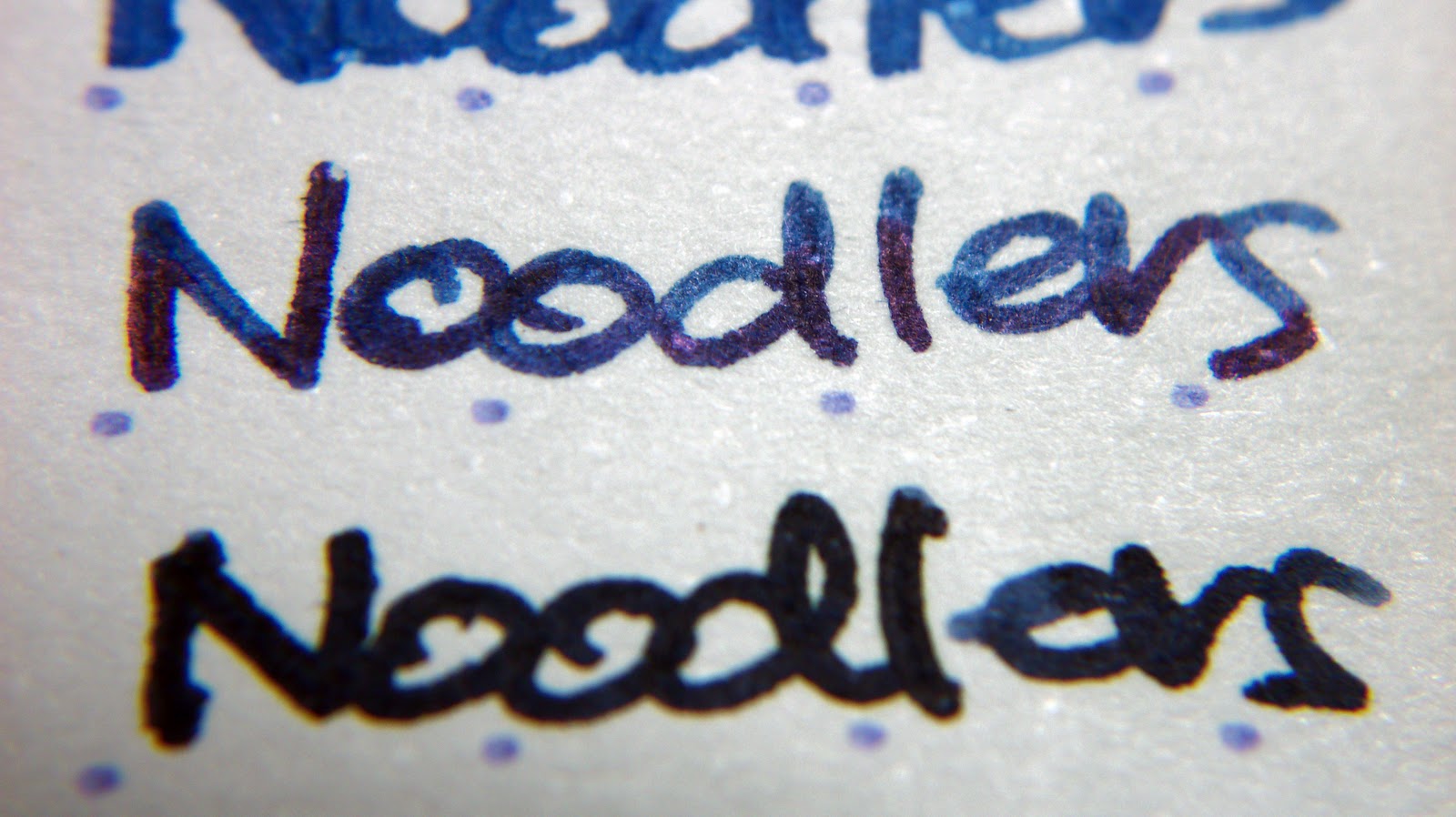
Below are some macro shots of different inks on the dotPad's paper. I realized that this is the perfect paper to test inks because most of the 'featherers' and 'bleeders' on my ink collection behaved beautifully on this paper.
Friday, 7 August 2009
The Search is (Almost) Over
I must admit that I'm new to this gel pen review stuff and it's an exciting project. My first three reviews were well-received, but I felt that somehow, something is still missing. Until I saw The Pen Addict's Signo review recently. I noticed that for all his reviews, The Pen Addict used the same paper, where he wrote with the pen being reviewed. And he only used a single photo: the pad (with his review written in longhand) and the pen. After reading that post, and seeing other pen reviews, I knew what I wanted to do with my reviews.
Not that I want to duplicate what The Pen Addict and other pen reviewers do, but I felt I could do something similar so I will have consistency in my reviews. I'll post more photos, of course, but I'd like to use just one pad, notebook, or paper type for my reviews. So during the weekend, I went out looking for a white, ruled pad that I can use to write on for my pen reviews. I had a very specific criteria in mind: 1) paper must be white so it won't interefere with ink colors; 2) paper must be ruled; 3) paper must resist feathering and bleed because I also plan to use it for my fountain pens.
As I browsed the stacks of various paper supplies at NBS, a pad caught my attention because of its blue lines. The 8x10in paper is immaculate white and the lines are printed in light blue. Think about Waterman South Sea Blue. Thickness is not very remarkable, but as an elementary pad paper, I don't think I should expect too much. I'm glad the paper is not shiny, which means it's not coated. After "feeling" the paper for some time, I went ahead and paid for it.
The Cattleya intermediate pad: heaven sent!
A closer look at the Cattleya pad's paper.
At home, I was like my four-year old niece in my excitement to try the new paper on my hands. I tried some of my gel pens first and it went well. No bleed, no feathering. I then took out my pen case and tried my inked daily warriors: medium Schneiders, Parkers, and Lamy Safari, Thein (my Frankenpen, a Sheaffer Thin Model), and Pilot 78G.
A test page showing different pens and inks on a page off the pad.
The ballpoints went okay, and writing is silky smooth, as is the gels and pencils. The Sharpies despite being ultra-fine points feathered and bled too much, but that's okay.

A closer look at the upper part of the test page.
Ballpoints, gels, markers, and pencils.
As I wrote the first line using my Schneider Base, I was super amazed - there wasn't any trace of feathering or bleeding even if the ink dried up fast! It looked (and felt) like I was writing with a ballpoint! (But only because the ink from my Schneider, a wet pen, did not feather or bleed.) I went to try my other pens as well - the very wet medium Lamy Safari, then my Parkers this time, and still, there wasn't any feathering or bleed! The long-awaited but tolerable bleed came when when I tried Thein, a medium Sheaffer. But that is okay, I guess. I've seen worse bleed on paper. :) And I must say that most of the FPs I tried fared better than the gels.
Here are the fountain pens, all with medium nibs: Lamy Safari (it should be M), Schneiders, Parker, Sheaffer and Pilot.
The back of the test page shows some "see-through", but it's not a bother at all. And I think some see-through (exhibited by some of the gels and fountain pens) is way better that the heavy bleed shown here by the Sharpies.
The pad's back board showing Cattleya's logo, its manufacturer and where it was manufactured.
And so the search for the THE (almost perfect) paper ended with with the Cattleya intermediate paper. Sold in pads of 90 leaves in 8x10in book paper, it's selling for PHP28.50, or approximately US$0.60! I will definitely go back to NBS this weekend and get more pads. This pad of paper is not only good for reviews, it's good for oodles and doodles too! Well, as another FPNP member said, the good stuff do not have to always be the expensive ones. *Wink.*